
An independent reference library, founded 2013
A library of Pagan, occult, esoteric, and mystical literature
The Adocentyn Athenaeum collects, shelves, and explains the books of the hidden and the holy: grimoires and star lore, Hermetic dialogues and alchemical emblems, hymns to the old gods and the testimony of the mystics. Read them with us in the reading room, or begin here with our guides.
What is the Adocentyn Athenaeum?
The Adocentyn Athenaeum is an on-site, non-lending reference library on the Pacific coast, devoted to one large and often misunderstood family of books: the literature of Paganism, occultism, esotericism, and mysticism. We were founded in 2013 by three readers who pooled their own shelves, and we are run entirely by volunteers.
Our purpose is to collect, preserve, describe, and make available the written record of these traditions, from the hymns and funerary texts of the ancient world to last season's coven newsletters, for practitioners, students, researchers, writers, and the simply curious. We keep the primary texts in translation, the scholarship that explains them, and the criticism that argues with them.
We are a library, not a lodge. We do not teach a practice, initiate anyone, or vouch for the claims made in the books we keep. We do believe this literature deserves the same careful cataloging and honest description as any other.
If you cannot reach us in person, the research guides, subject tree, glossary, and chronology on this site are written to be useful wherever you read.
The Athenaeum at a glance
- Founded
- 2013. The reading room opened in 2016.
- Holdings
- About 11,400 cataloged volumes, 2,600 periodical issues, and 38 boxes of ephemera.
- Use
- On site only. Nothing circulates and nothing is for sale.
- Cost
- Day use is free. Reader tickets help pay the rent.
- Run by
- Volunteer keepers and a board of trustees.
- Visits
- Open Wednesday, Thursday, and Saturday, and the first Sunday of each month. Directions are sent on request.
Enter by the Four Gates
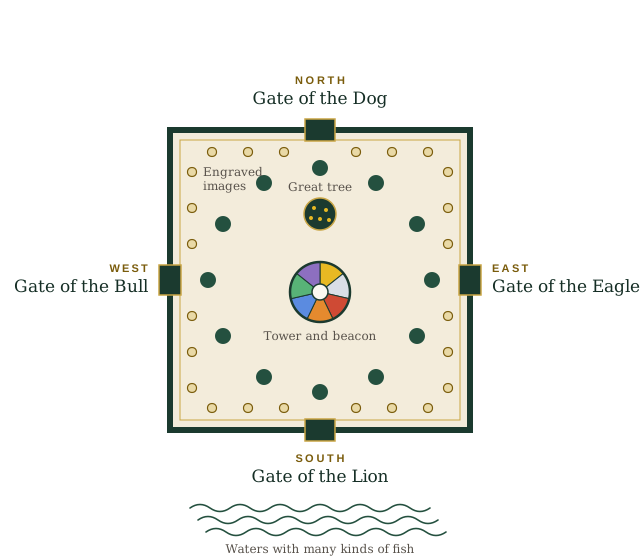
Adocentyn had four gates, each watched over by an image. Our shelves are arranged the same way: four gates, four literatures, with the reference collection in the tower at the center.
-
East Gate Gate of the Eagle
Mystical Literature
The literature of direct experience: Plotinus and the later Platonists, the Christian contemplatives, the Sufi poets, and the comparative study of mysticism.
-
South Gate Gate of the Lion
Occult Literature
The practical arts and their handbooks: ceremonial magic and the grimoires, astrology, alchemy, divination, tarot, and natural magic.
-
West Gate Gate of the Bull
Pagan Literature
The gods and their people: ancient hymns and myths, the Eddas and the Mabinogion, folklore, and the books of the modern Pagan revival.
-
North Gate Gate of the Dog
Esoteric Literature
The hidden teachings and how they were handed on: the Hermetica, Gnostic scriptures, Kabbalah, the Rosicrucian manifestos, and Theosophy.
Why "Adocentyn"?
The name comes from medieval Arabic and Latin Hermetic literature, most notably the Picatrix, the Latin version of an Arabic handbook of astral magic. There Adocentyn is a legendary city founded in ancient Egypt by Hermes Trismegistus, the thrice-great sage, as a center of wisdom and astronomical magic.
The story gives the city four gates guarded by speaking images of an eagle, a bull, a lion, and a dog; a great tree bearing every kind of fruit; and a tower crowned with a light whose color changed on each of the seven days. Images engraved around the city kept the citizens virtuous and safe from harm.
Our founders chose the name as a nod to building a city of wisdom in the West: a place on the far western shore where the books of these traditions could be gathered, kept safe, and read by anyone who came to the gate.
Research Guides
Each guide introduces one body of literature: what the key texts are, when and where they were written, which to read first, and what to watch for along the way. New to the subject? Begin with Starting Your Research.
-
Hermetic Literature
The Corpus Hermeticum, the Asclepius, the Emerald Tablet, the technical Hermetica, the Picatrix, and the Renaissance revival.
-
Grimoires and Ceremonial Magic
The magical papyri, the Solomonic handbooks, Agrippa and the learned magic of the Renaissance, the popular chapbooks, and the modern revival.
-
Alchemy
Greek, Arabic, and Latin alchemy, the great emblem books, Paracelsus, and the spiritual and psychological readings.
-
Astrology
Babylonian omens, Ptolemy and Vettius Valens, the Arabic masters, William Lilly, Indian astrology, and the critics.
-
Divination and Tarot
Cicero and Artemidorus, lot books, the I Ching, geomancy, and the documented history of the tarot from card game to oracle.
-
Kabbalah
Sefer Yetzirah, the Bahir, the Zohar, Cordovero and Luria, Christian Cabala, and the Hermetic Qabalah of the occult revival.
-
Gnostic and Neoplatonic Texts
The Nag Hammadi library and other Gnostic scriptures, with Plotinus, Iamblichus, the Chaldean Oracles, and Proclus.
-
Witchcraft and Modern Paganism
The trial-era treatises and their critics, the romantic reinvention of the witch, Gardner and Wicca, Druidry, and the wider Pagan revival.
-
Mystical Classics
Dionysius, Eckhart, the English mystics, Teresa and John of the Cross, the Sufi poets, Asian classics, and the modern studies.
From the Journal
Essays by the keepers and trustees on the history of these books and the craft of reading them.
-
Monastic Libraries and Hermetic Texts
How the books of Hermes came through the Middle Ages: less by secret vaults than by ordinary copying, lucky miscellanies, and translators working between languages.
-
What Is a Grimoire?
A book of magic is first of all a book. Where the word comes from, what a grimoire contains, who owned such books, and how to read one.
-
Reading the Picatrix
The book that gave us our name is long, repetitive, learned, and strange. What is in its four books, who read it, and how to approach it.
Hours of Operation
Open Wednesday, Thursday, Saturday, and first Sundays
- Wednesday12:00 noon to 7:00 pm
- Thursday12:00 noon to 7:00 pm
- Saturday10:00 am to 5:00 pm
- First Sunday of the month12:00 noon to 4:00 pm
- Any other dayBy appointment
All times are Pacific time. We are closed from December 20 to January 2. To arrange an appointment, write to desk@adocentyn.us at least a week ahead. What to expect on a visit.
Reader Tickets
Anyone may read here for the day without charge. A reader ticket adds stack access and a reserved shelf, and keeps the lamps lit.
Wayfarer
Day use | No ticket needed
Sign the register at the desk.
Free
Resident
One year | Stack access
Photo identification at the desk.
$40 requested
Lamplighter
One year | Stack access
For readers who can give more.
$120 requested
Tickets are issued in person. We take no payments through this website. How reader tickets work.
Keepers and Trustees
-
Tamsin Hollowell
Keeper of the Collections
-
Desmond Varga-Lind
Cataloger
-
Miriam Kestrel
Keeper of Periodicals and Ephemera
-
Rafael Ibarra-Stone
Reading Room Steward
-
Dr. Imogen Pryce-Navarro
Trustee and Journal Editor
-
Corwin Halloran
Trustee and Conservator
-
Odalys Brennan-Wu
Trustee and Treasurer