
The city in the Picatrix
The name Adocentyn derives from medieval Arabic and Latin Hermetic literature, most notably the Picatrix. In the third chapter of its fourth book, among stories of the wonders worked by the sages of old, the Picatrix turns to Hermes Trismegistus. He was, it says, the first to make magical images, and by them he governed the flooding of the Nile. He raised a temple to the Sun. And then he built a city.
What follows is our paraphrase of the Latin text:
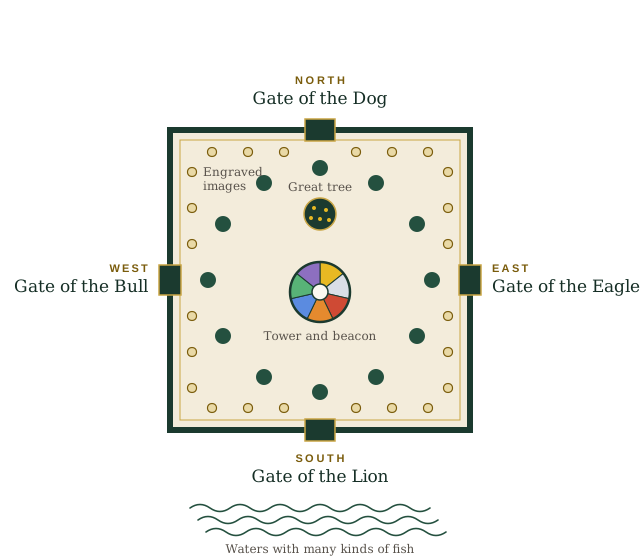
In the east of Egypt he built a city twelve miles long, and within it a castle with a gate on each of its four sides. On the eastern gate he set the image of an eagle, on the western the image of a bull, on the southern a lion, and on the northern a dog. Into these images he caused spirits to enter, which spoke aloud, and no one could pass the gates without their leave.
There he planted trees, and in their midst one great tree that bore the fruit of every kind. On the summit of the castle he raised a tower thirty cubits high, and on top of it a globe whose color changed each day until the seventh day, when it returned to the first; and the whole city was lit with its color. Near the city was an abundance of water, in which lived fish of many kinds.
Around the circumference of the city he set engraved images, so ordered that by their power the inhabitants were made virtuous and kept from all wickedness and harm. The name of the city was Adocentyn.
That is all the text says. Strictly, the Latin sets the four gates in the castle at the heart of the city, though later retellings, ours included, speak more loosely of the four gates of Adocentyn. It is a city in which astronomy, architecture, and ethics are one craft: the stars are drawn down into images, and the images make the people good. In Hermetic tradition Adocentyn stands as a mythic center of wisdom and astronomical magic.
Where the story comes from
The Picatrix is the Latin translation, made by way of Castilian in the middle of the thirteenth century, of an Arabic work called Ghayat al-Hakim, The Goal of the Wise, compiled in Muslim Spain two or three centuries earlier. In the Arabic the city is al-Ashmunain, the Arabic name for the ancient Egyptian town that the Greeks called Hermopolis, the city of Hermes, long sacred to Thoth. Scholars generally take "Adocentyn" to be what remained of that name after it had passed through two translations and the pens of many copyists.
The story belongs to a larger body of medieval Arabic lore in which Hermes appears as an ancient king and sage of Egypt, a builder of temples and a maker of talismans. For more on the book itself, see our essay Reading the Picatrix and the guide to Hermetic literature.
A city toward the setting sun
A second Hermetic text stands behind our motto, "A City of Wisdom in the West". The Latin Asclepius contains a famous lament in which Hermes foretells a time when the old religion of Egypt will be abandoned and the gods will withdraw from the earth. The prophecy does not end in loss. The gods, it says, will one day be restored and settled in a city at the furthest edge of Egypt, founded toward the setting sun, to which people will hasten by land and by sea.
Twentieth-century historians of the Hermetic tradition pointed out how well the magical city of the Picatrix answers to that promised city, and how both seem to stand behind the ideal cities imagined by Renaissance writers, Campanella's City of the Sun among them. Whether or not the medieval compiler intended the connection, later readers made it.
Why we chose it
When our founders needed a name in 2013, they wanted one that said what they meant: a walled garden of learning, open at four gates to anyone who asks, with a light on top that can be seen from a distance. They selected the name as a nod to building a "city of wisdom" in the West. Our reading room stands near the Pacific shore, facing the setting sun, about as far toward evening as the continent goes.
We should be plain about one thing. The city never existed, and we do not pretend otherwise. It is a story about what a place of knowledge might be, and stories of that kind are exactly what this library keeps.
How the city organizes the library
| Feature | In the legend | At the Athenaeum |
|---|---|---|
| Four gates | Eagle to the east, bull to the west, lion to the south, dog to the north | The four main collections |
| The tower | Thirty cubits high, on the summit of the castle | Reference and bibliography, shelved in the middle of the room |
| The beacon | A globe that changes color on each of seven days | The colored lamp in our front window, and the dot at the top of this page |
| The great tree | Bears the fruit of every kind | The subject tree |
| The waters | Abundant, with fish of many kinds | Periodicals and ephemera |
| The engraved images | Keep the citizens virtuous and free from harm | The customs of the reading room, posted by the door |
Assigning each literature to a gate was our cataloger's decision, not the Picatrix's. The text names the animals and their directions and says no more.
The seven colors of the beacon
The Latin text does not say which colors the globe showed. Because the seven days of the week have carried the names of the seven classical planets since late antiquity, we borrow the planetary colors of later astrological tradition. The sources differ in their details, so treat this as a house convention and not as a quotation.
| Day | Planet | Color of the beacon |
|---|---|---|
| Sunday | The Sun | Gold |
| Monday | The Moon | Silver |
| Tuesday | Mars | Red |
| Wednesday | Mercury | Orange |
| Thursday | Jupiter | Blue |
| Friday | Venus | Green |
| Saturday | Saturn | Violet |
Saying the name
No one knows how a thirteenth-century translator would have pronounced it. We say ad-oh-SEN-tin, with the stress on the third syllable, and we answer to most other attempts.